
Benevolence
On the Square: A Handbook for Freemasons” (1923) by William Hy Beable is a foundational guide designed for initiates. It covers topics like the square’s symbolism, lodge structure, and the obligations of members to act with integrity. Written by William Hy Beable a member of the Aldwych Club Lodge 3794, it aims to educate new members on behaving “on the square”—meaning honestly and straightforwardly
On the Square
By W. H. Beable
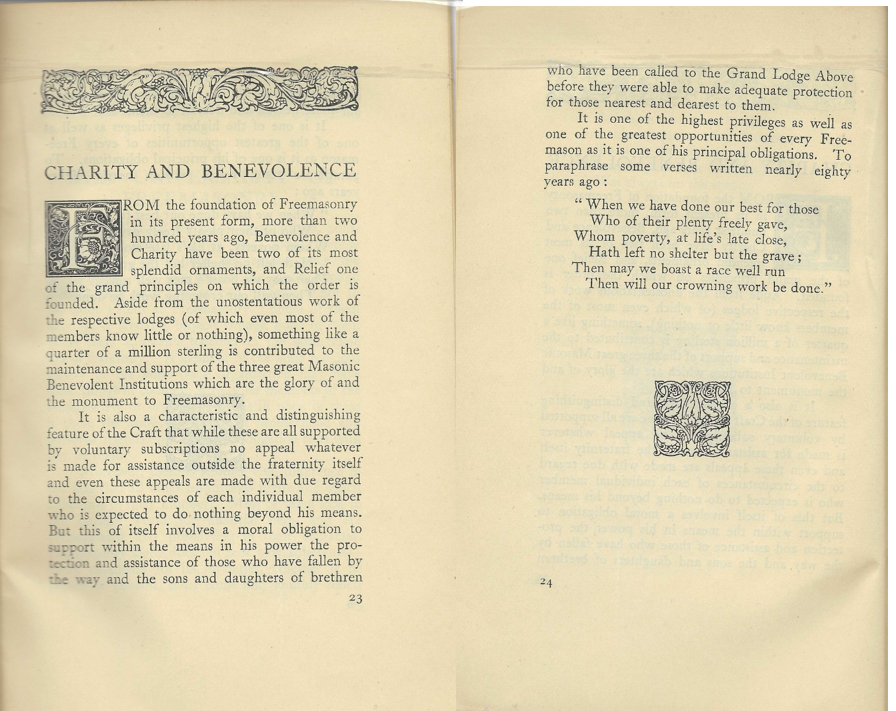
Charity and benevolence
FROM the foundation of Freemasonry in its present form, more than two hundred years ago, Benevolence and Charity have been two of its most splendid ornaments, and Relief one of the grand principles on which the order is founded. Aside from the unostentatious work of the respective lodges (of which even most of the members know little or nothing), something like a quarter of a million sterling is contributed to the maintenance and support of the three great Masonic Benevolent Institutions which are the glory of and the monument to Freemasonry.
It is also a characteristic and distinguishing feature of the Craft that while these are all supported by voluntary subscriptions no appeal whatever is made for assistance outside the fraternity itself and even these appeals are made with due regard to the circumstances of each individual member who is expected to do nothing beyond his means. But this of itself involves a moral obligation to sepport within the means in his power the protection and assistance of those who have fallen by the wey and the sons and daughters of brethren who have been called to the Grand Lodge Above before they were able to make adequate protection for those nearest and dearest to them. :
Tt is one of the highest privileges as well as one of the greatest opportunities of every Freemason as it is one of his principal obligations. ‘To paraphrase some verses written nearly eighty years ago:
“When we have done our best for those
Who of their plenty freely gave,
Whom poverty, at life’s late close,
Hath left no shelter but the grave;
Then may we boast a race well run ‘
Then will our crowning work be done.”
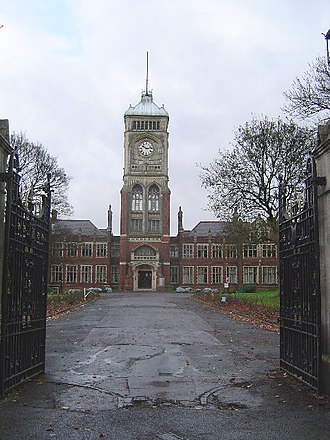
Royal Masonic Institution for Boys
The origins of the school lie in the charities established in the late 18th century to clothe and educate the sons of Freemasons near their homes. These charities amalgamated in 1852 and established a boys’ school at Wood Green in North London in 1857.[1] The foundation stone for a new school in Bushey was laid by the Duke of Connaught and Strathearn.[2] It was designed by Gordon & Gunton[3][4] and completed in 1903.[5] A Junior School was added on the other side of The Avenue in 1929 and by 1939 there were 800 boys at the school.[1][6]
Following a decline in pupil numbers the junior school closed in 1970, with the senior school closing in 1977. The site of the junior school is now occupied by The Grange Academy.
On the Square
By W. H. Beable
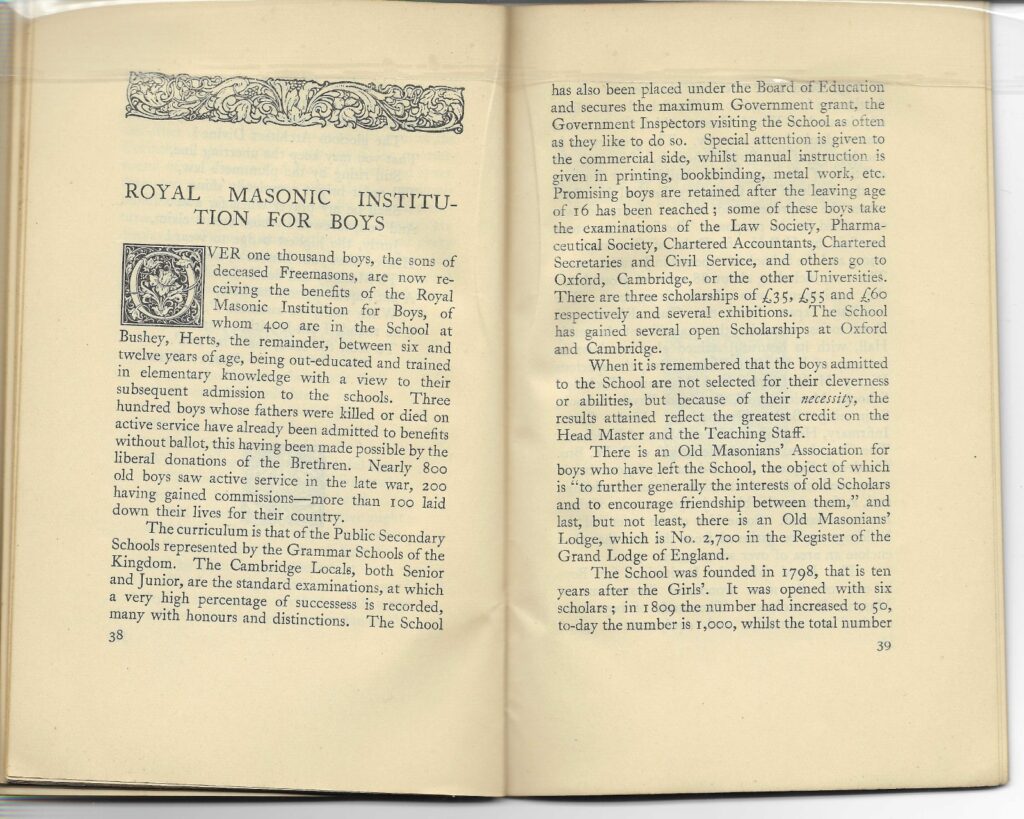
Royal Masonic Institution for Boys
ROYAL MASONIC INSTITUTION FOR BOYS Over one thousand boys, the sons of deceased Freemasons, are now receiving the benefits of the Royal Masonic Institution for Boys, of whom 400 are in the School at Bushey, Herts, the remainder, between six and twelve years of age, being out-educated and trained in elementary knowledge with a view to their subsequent admission to the schools. Three hundred boys whose fathers were killed or died on active service have already been admitted to benefits without ballot, this having been made possible by the liberal donations of the Brethren. Nearly 800 old boys saw active service in the late war, 200 having gained commissions — more than 100 laid down their lives for their country.
The curriculum is that of the Public Secondary Schools represented by the Grammar Schools of the Kingdom. The Cambridge Locals, both Senior and Junior, are the standard examinations, at which a very high percentage of successes is recorded, many with honours and distinctions. The School has also been placed under the Board of Education and secures the maximum Government grant, the Government Inspectors visiting the School as often as they like to do so. Special attention is given to the commercial side, whilst manual instruction is given in printing, bookbinding, metal work, etc. Promising boys are retained after the leaving age of 16 has been reached; some of these boys take the examinations of the Law Society, Pharmaceutical Society, Chartered Accountants, Chartered Secretaries and Civil Service, and others go to Oxford, Cambridge, or the other Universities. There are three scholarships of £35, £55 and £60 respectively and several exhibitions. The School has gained several open Scholarships at Oxford and Cambridge.
When it is remembered that the boys admitted to the School are not selected for their cleverness or abilities, but because of their necessity, the results attained reflect the greatest credit on the Head Master and the Teaching Staff. There is an Old Masons’ Association for boys who have left the School, the object of which is “to further generally the interests of old Scholars and to encourage friendship between them,” and last, but not least, there is an Old Masons’ Lodge, which is No. 2,700 in the Register of the Grand Lodge of England.
The School was founded in 1798, that is ten years after the Girls’. It was opened with six scholars; in 1809 the number had increased to 50, to-day the number is 1,000, whilst the total number of boys who have received the benefit of the Institution is over 4,600. The School was originally located at Wood Green, which at that time was no doubt in the country. The great event in the history of the Boys’ School is, of course, the erection of the magnificent buildings at Bushey, as the result of the Centenary Festival in 1898, when the unprecedented sum of £141,000 was subscribed for the purpose. The foundation stone was laid by H.R.H. the Duke of Connaught in 1900, and the School was opened in January, 1903. The cost, including about 88 acres of ground and the equipment, was about £199,000. The buildings, apart from the Class Rooms and Dormitories, comprise the magnificent Assembly Hall, with its beautiful stained glass windows in memory of V.W. Bro. Richard Eve, the spacious Dining Hall, Library and Museum, Technical Schools, Music School, Arts and Physic Schools, Swimming Bath, Gymnasium, Fives Court, Infirmary, Hospital, and Head Masters’ Residence. The Chapel was the munificent gift of R.W. Bro. Charles E. Keyser. It is said that 7,609,000 bricks were used in the construction of these buildings, and, as far as one is able to judge, not one of these has been wasted. Some idea of the extent of the buildings can be gathered from the fact that they enclose an area of over seven acres.
The Royal Masonic Institution for Boys is one of the most wonderful illustrations of Masonic Benevolence. Thousands of boys have received an education and equipment as good as, if not better, than most of us can give to our own sons.
Can they not say:
“Our boast is not that we deduce our birth
From loins enthroned, or rulers of the earth,
But higher far our proud pretentions rise,
The sons of Masons passed into the skies.”
Royal Masonic Institution for Girls
The Royal Masonic School for Girls (RMS) is a private school in Rickmansworth, Hertfordshire, England, with day and boarding pupils. The school was instituted in 1788, with the aim of caring for the daughters of poor Freemasons. In 1978, the school opened to girls beyond the daughters of freemasons.[2]
The school opened in 1789 with fifteen pupils in Somers Town, St Pancras, Middlesex. The school has moved between premises three times, twice within London and in 1934 to Rickmansworth in Hertfordshire, where it still is today.
The Royal Masonic School is a day school for girls 4–18 and a boarding school for girls 7–18. A nursery opened in 2009 for boys and girls aged 2–4 years
On the Square
By W. H. Beable
Royal Masonic Institution for Girls
Few minutes’ walk from Clapham Junction station, on the high ground overlooking Wandsworth and the neighbourhood, is a handsome pile of buildings standing in its own grounds and known as the Royal Masonic Institution for Girls. For over 134 years this has been one of the outstanding marks of Masonic Benevolence and is the oldest of the three Masonic Charities.
Since its foundation 3,967 girls have received its benefits. There are now 950 girls receiving the benefits, the General Courts in April and October last having decided to admit without ballot the whole of the 78 Candidates for Election; whilst 106 further nominations for Out-education without Election were granted, making a total of 184 girls added during the present year. 600 out-education nominations for girls at any age between 6 and 15 (the General Committee having power on sufficient cause being shewn to extend the grant to 16 or even 17) have been allotted to the Provinces, Districts, and London in proportion to their voting power.
1,207 girls have already benefited under this scheme. 400 Special War Nominations for the daughters of Brethren killed or totally incapacitated during the war have also been made available for any Lodges on the Register of the Grand Lodge of England. These 1,000 nominations are by way of grant, and are at no time subject to Election. At a Special General Court, held on April 7th, 1921, the amounts allowed for out-education grants were increased by over 50 per cent. to a maximum of £50 per annum. Grants are also made to assist deserving girls to continue their education at a University or elsewhere.
The education provided at the Girls’ School is founded on thoroughly sound principles, with a bias towards domestic science, and may be compared to that of the Public Secondary Schools. The girls are prepared for various public examinations, such as Cambridge Locals, Associated Board of Music, The Royal Drawing Society, etc. The efficiency is shown by the very large percentage of successes during the last 33 years, out of 1,277 candidates entered for the Cambridge Local Examinations, no less than 1,219 have passed, many with honours and distinctions. Domestic Science is represented by courses of instruction in needlework, practical cookery, as well as the domestic duties of the house. There is also a commercial side, including such subjects as shorthand and typewriting, whilst the bodily development of the girls is promoted by physical drill, organised games, swimming, etc. A new Chemical Laboratory, thoroughly equipped, has been recently added.
In accordance with the policy of the Institution practically every member of the Resident Staff has been educated in the School, several having University degrees, and others special teaching qualifications. This fact has brought about an excellent esprit de corps, besides preserving the Masonic traditions of the School. There is an Old Masonic Girls’ Association to maintain an interest in the School and for other excellent purposes.
As W. Bro. Robinson says in his interesting lecture: “With such highly trained staffs of teachers and such splendid buildings, specially designed and built for the purpose, it is no wonder that both schools (the Boys’ and the Girls’) are in such a high state of efficiency, and provide, as they do, a liberal and virtuous education, whereby the human representative of the Rough Ashlar, received in a primitive state, rough and unpolished, is wrought into due form, and is thereby rendered a fit member of civilised society.”

RMBI Care Co. (formerly Royal Masonic Benevolent Institution)
RMBI (https://rmbi.org.uk) is the primary charity affiliated with the United Grand Lodge of England (UGLE) that has cared for older people for over 180 years. It supports residents across 17 care homes in England and Wales, focusing on wellbeing and independence.
On the Square
By W. H. Beable
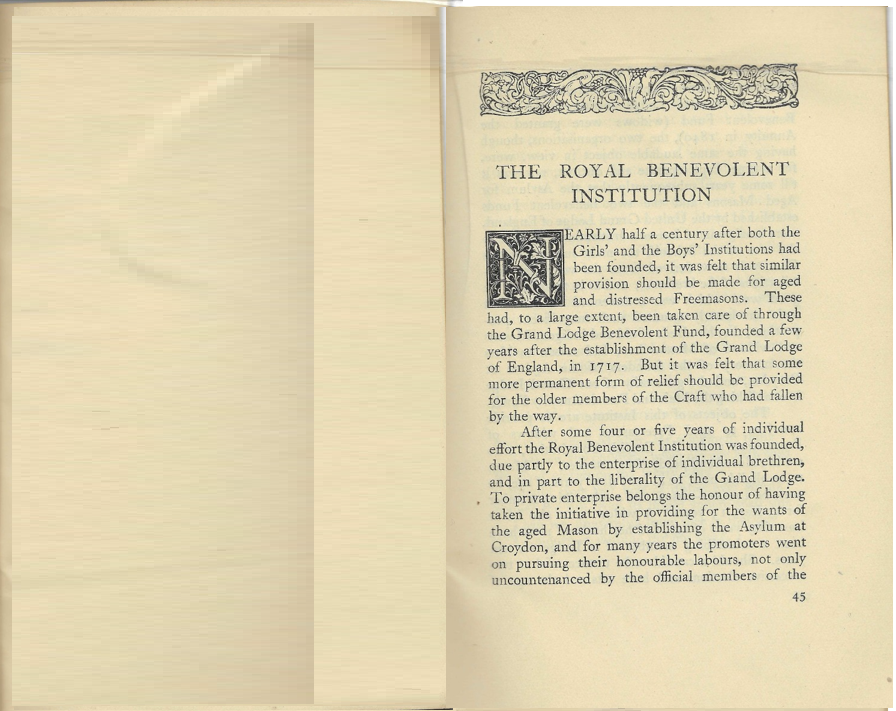
The Royal Benevolent Institution
Nearly half a century after both the Girls’ and the Boys’ Institutions had been founded, it was felt that similar provision should be made for aged and distressed Freemasons. These had, to a large extent, been taken care of through the Grand Lodge Benevolent Fund, founded a few years after the establishment of the Grand Lodge of England, in 1717. But it was felt that some more permanent form of relief should be provided for the older members of the Craft who had fallen by the way.
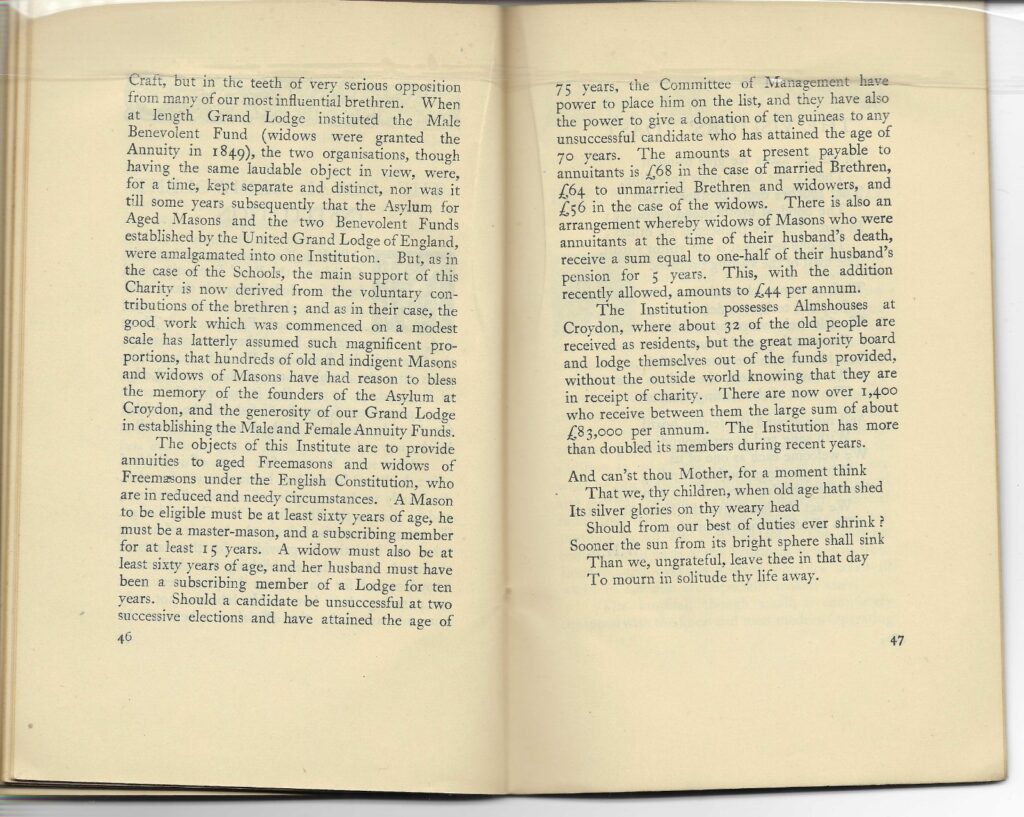
After some four or five years of individual effort the Royal Benevolent Institution was founded, due partly to the enterprise of individual brethren, and in part to the liberality of the Grand Lodge. To private enterprise belongs the honour of having taken the initiative in providing for the wants of the aged Mason by establishing the Asylum at Croydon, and for many years the promoters went on pursuing their honourable labours, not only uncountenanced by the official members of the Craft, but in the teeth of very serious opposition from many of our most influential brethren.When at length Grand Lodge instituted the Male Benevolent Fund (widows were granted the Annuity in 1849), the two organisations, though having the same laudable object in view, were, for a time, kept separate and distinct, nor was it till some years subsequently that the Asylum for Aged Masons and the two Benevolent Funds established by the United Grand Lodge of England were amalgamated into one Institution. But, as in the case of the Schools, the main support of this Charity is now derived from the voluntary contributions of the brethren; and as in their case, the good work which was commenced on a modest scale has latterly assumed such magnificent proportions, that hundreds of old and indigent Masons and widows of Masons have had reason to bless the memory of the founders of the Asylum at Croydon, and the generosity of our Grand Lodge in establishing the Male and Female Annuity Funds.
The objects of this Institute are to provide annuities to aged Freemasons and widows of Freemasons under the English Constitution, who are in reduced and needy circumstances. A Mason to be eligible must be at least sixty years of age, he must be a Master Mason, and a subscribing member for at least 15 years. A widow must also be at least sixty years of age, and her husband must have been a subscribing member of a Lodge for ten years. Should a candidate be unsuccessful at two successive elections and have attained the age of 75 years, the Committee of Management have power to place him on the list, and they have also the power to give a donation of ten guineas to any unsuccessful candidate who has attained the age of 70 years.
The amounts at present payable to annuitants is £68 in the case of married Brethren, £64 to unmarried Brethren and widowers, and £56 in the case of the widows. There is also an arrangement whereby widows of Masons who were annuitants at the time of their husband’s death, receive a sum equal to one-half of their husband’s pension for 5 years. This, with the addition recently allowed, amounts to £44 per annum.
The Institution possesses Almshouses at Croydon, where about 32 of the old people are received as residents, but the great majority board and lodge themselves out of the funds provided, without the outside world knowing that they are in receipt of charity. There are now over 1,400 who receive between them the large sum of about £83,000 per annum. The Institution has more than doubled its members during recent years.
And can’st thou Mother, for a moment think
That we, thy children, when old age hath shed
Its silver glories on thy weary head
Should from our best of duties ever shrink?
Sooner the sun from its bright sphere shall sink
Than we, ungrateful, leave thee in that day
To mourn in solitude thy life away
On the Square
By W. H. Beable
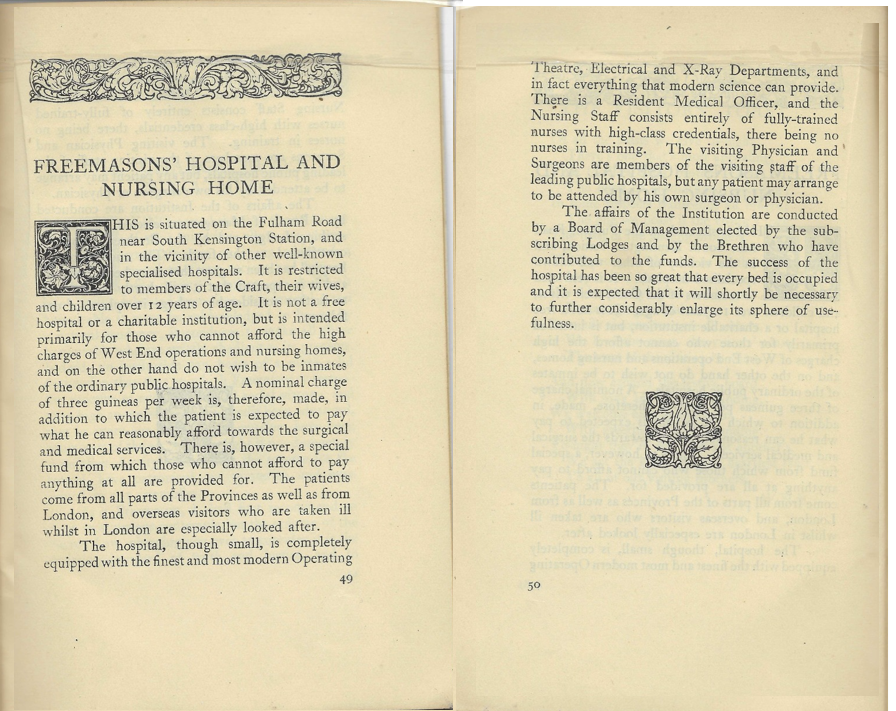
Freemasons’ Hospital and nursing home
This is situated on the Fulham Road near South Kensington Station, and in the vicinity of other well-known specialised hospitals. It is restricted to members of the Craft, their wives, and children over 12 years of age. It is not a free hospital or a charitable institution, but is intended primarily for those who cannot afford the high charges of West End operations and nursing homes, and on the other hand do not wish to be inmates of the ordinary public hospitals. A nominal charge of three guineas per week is, therefore, made, in addition to which the patient is expected to pay what he can reasonably afford towards the surgical and medical services. There is, however, a special fund from which those who cannot afford to pay anything at all are provided for. The patients come from all parts of the Provinces as well as from London, and overseas visitors who are taken ill whilst in London are especially looked after.
The hospital, though small, is completely equipped with the finest and most modern Operating Theatre, Electrical and X-Ray Departments, and in fact everything that modern science can provide.
There is a Resident Medical Officer, and the Nursing Staff consists entirely of fully-trained nurses with high-class credentials, there being no nurses in training. The visiting Physician and Surgeons are members of the visiting staff of the leading public hospitals, but any patient may arrange to be attended by his own surgeon or physician.
The affairs of the Institution are conducted by a Board of Management elected by the subscribing Lodges and by the Brethren who have contributed to the funds. The success of the hospital has been so great that every bed is occupied and it is expected that it will shortly be necessary to further considerably enlarge its sphere of usefulness.

Why Join
Freemasonry offers a structured journey of moral reflection and self-discovery, conveyed through a series of allegorical ceremonial dramas. These staged teachings, traditionally learned and performed by members within the lodge, use symbolism and narrative to illuminate ethical principles and encourage personal growth.
View →

How to join
A common misconception about Freemasonry is that a man must be invited to become a member. This is not true.
There is no requirement to wait for an invitation. On the contrary, the proper and traditional way to begin the journey into Freemasonry is for a man to express his own interest and ask to join.
View →
Lodge Meeting Dates
The regular meetings are held four times per year on:
4th Tuesday in October, 3rd Monday in December, 3rd Wednesday in February and 3rd Tuesday in May within the magnificent building, Freemasons Hall, Covent Garden, 60 Great Queen Street,
London WC2 5AZ